International shipping allows businesses to move products across countries and continents, connecting manufacturers, suppliers, and customers around the world. However, transporting goods by sea, air, road, or a combination of these methods exposes shipments to risks that can cause significant financial losses.
Cargo may be damaged by rough weather, lost during handling, stolen, or affected by accidents while in transit. For businesses that depend on imported or exported goods, a single major loss can disrupt operations and create unexpected expenses.
Marine insurance helps reduce these financial risks by providing coverage for eligible losses involving goods in transit. Understanding how it works can help importers, exporters, and other businesses protect their shipments and manage international trade more confidently.
1. What Is Marine Insurance?
Marine insurance is a type of insurance designed to protect against specified risks associated with maritime activities and the movement of goods.
Although its name suggests protection only for sea transport, marine cargo insurance can also cover goods transported by road, rail, or air as part of an insured journey, depending on the policy.
For example, a Tanzanian business importing electronic equipment from Asia may arrange cargo insurance to protect the shipment while it travels by sea and continues by road to its final destination.
The exact protection depends on the policy wording, the insured journey, the goods being transported, and the exclusions that apply.
Marine insurance is particularly valuable when a shipment represents a substantial financial investment that a business could struggle to replace after an unexpected loss.
2. What Risks Does Marine Insurance Cover?
Marine cargo insurance can protect against several types of loss or damage, depending on the coverage selected.
Common insured risks may include:
- Damage caused by certain accidents during transportation.
- Loss of cargo following an insured shipping incident.
- Theft or non-delivery of insured goods under covered circumstances.
- Damage caused by certain weather-related events.
- Loss or damage during loading, unloading, or handling, where included in the policy.
For example, a shipment of furniture may be damaged if a container falls during port handling. If the incident falls within the policy’s coverage, the cargo owner may be able to claim compensation.
However, not every event is automatically covered. Policies may exclude losses caused by inadequate packaging, ordinary wear and tear, delay, or the inherent nature of the goods.
Before purchasing coverage, review the specific risks insured and the exclusions that could affect your shipment.
3. Why International Shipping Needs Insurance
International shipments often pass through several locations and involve multiple companies, including exporters, freight forwarders, shipping lines, port operators, customs agents, and road transport providers.
Every stage can introduce risks.
Goods may be transferred between containers, stored temporarily at ports, or transported across long distances before reaching the buyer. If something goes wrong, determining where the damage occurred and who is responsible can take time.
Marine insurance can provide a more direct route to compensation for covered losses without relying exclusively on a claim against a carrier or another party.
This does not eliminate the need to investigate responsibility, and the insurer may pursue recovery from a responsible party where legally permitted.
For businesses, insurance can also make financial planning easier by reducing uncertainty around the potential cost of major cargo losses.
4. Understanding Different Types of Marine Cargo Coverage
Not every shipment needs the same level of protection. Insurers may offer different coverage arrangements depending on the goods, route, transport method, and business requirements.
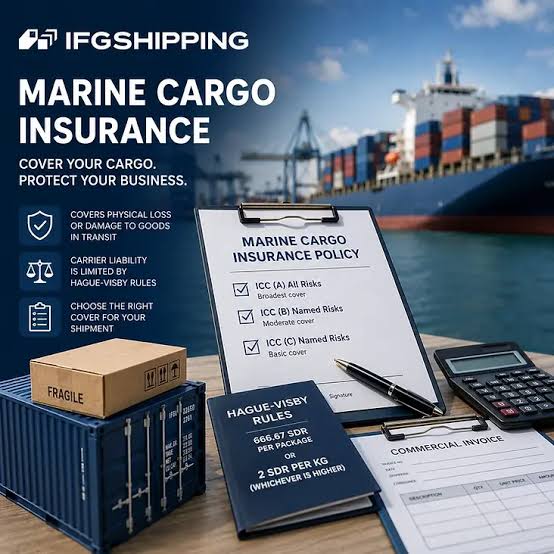
All-risks-style cargo cover: Often provides broad protection against accidental physical loss or damage, subject to policy exclusions and conditions. Despite the name, it does not cover every possible loss.
Named-perils cover: Protects against specific risks listed in the policy, such as certain fires, collisions, or other insured events.
Single-shipment insurance: Covers a particular shipment or journey.
Open cargo or annual policies: May cover multiple shipments over a specified period, subject to reporting requirements, limits, and policy conditions.
For example, a company that imports goods every month may find an annual cargo policy more practical than arranging separate insurance for every shipment.
The best arrangement depends on shipment frequency, cargo value, destinations, and the terms offered by the insurer.
5. Who Is Responsible for Insuring the Goods?
Responsibility for arranging marine insurance depends partly on the sales contract and the agreed delivery terms.
In international trade, buyers and sellers often use Incoterms, which help define responsibilities for transportation, costs, delivery, and risk transfer.
For example, under the commonly used CIF term—Cost, Insurance and Freight—the seller generally arranges minimum insurance for the sea or inland-waterway journey to the named destination port, subject to the applicable Incoterms rules and contract. Under FOB—Free on Board—the seller generally delivers the goods on board the vessel, and risk ordinarily transfers to the buyer at that point.
Other terms allocate responsibilities differently. Under some arrangements, the buyer may be responsible for arranging insurance, while under others the seller must provide it.
Importantly, responsibility for risk and responsibility for purchasing insurance are not always the same thing.
Buyers and sellers should confirm the exact Incoterms version, named place or port, and contract wording before deciding who must arrange coverage.
6. How Is the Insured Value of Goods Determined?
The insured value is an important factor because it helps determine the maximum amount potentially payable for a covered loss.
Depending on the policy, valuation may consider the invoice value of the goods, freight charges, insurance costs, and other agreed expenses. Some arrangements also include an agreed percentage to account for additional costs associated with the transaction.
For example, a shipment valued at $20,000 may have an insured value calculated using the goods’ value and eligible transportation expenses.
However, the insured value must follow the policy’s valuation provisions. It should not be assumed that every cost or expected profit is automatically covered.
Underinsuring a shipment may leave a business unable to recover its full financial loss. Overinsuring it does not necessarily guarantee a larger payment, because settlement remains subject to the policy terms and applicable insurance principles.
Keep invoices, packing lists, freight documents, and other records that support the declared value.
7. What Happens When Goods Are Damaged or Lost?
If cargo is damaged, stolen, or lost during an insured journey, the policyholder should notify the insurer as soon as reasonably possible and follow the claims procedure.
The process commonly involves several steps:
- Document the loss: Take photographs and record the condition of the goods, packaging, and containers where possible.
- Notify relevant parties: Inform the insurer, freight forwarder, carrier, or other responsible parties as required.
- Preserve evidence: Keep invoices, packing lists, shipping documents, delivery records, and inspection reports.
- Arrange an assessment: The insurer may appoint a surveyor or request an independent inspection.
- Submit the claim: Provide the required documents and explain the nature and extent of the loss.
Avoid discarding damaged goods or packaging before receiving guidance, unless necessary for safety or to prevent further damage.
Prompt reporting and clear documentation can help the insurer assess the claim more efficiently.
8. What Marine Insurance Usually Does Not Cover
Marine insurance policies commonly contain exclusions and conditions that policyholders must understand.
Depending on the policy, exclusions may apply to:
- Inadequate or unsuitable packaging.
- Ordinary wear and tear.
- Inherent defects or the natural deterioration of certain goods.
- Loss caused by delay alone.
- Certain deliberate or unlawful acts.
- Risks specifically excluded by the policy, which may include certain war-related or strike-related risks unless separately covered.
For example, if food products spoil because of inadequate temperature control, the claim may depend on whether the policy covers that type of deterioration and whether the required handling conditions were maintained.
Some excluded risks may be insurable under separate extensions, but this must be confirmed before the shipment begins.
Read the exclusions carefully and ask the insurer to explain any condition that could be especially important for your cargo.
9. How Businesses Can Choose the Right Marine Insurance
Selecting suitable cargo insurance requires more than comparing premiums.
Businesses should consider:
- Cargo type: Fragile, perishable, high-value, and hazardous goods may require specialized terms.
- Shipping route: Longer journeys and multiple transfers may introduce additional risks.
- Transport method: Sea, air, road, and combined journeys may have different coverage requirements.
- Shipment value: Ensure the declared value follows the policy’s valuation rules.
- Coverage limits: Confirm that the policy can cover the full value of the shipment.
- Deductibles: Understand the amount the business must pay toward a covered loss.
- Exclusions: Check for risks that are not covered or require additional protection.
- Claims procedures: Find out which documents and reporting deadlines apply.
Businesses shipping frequently may also want to compare annual policies with single-shipment coverage.
A qualified insurance broker or cargo insurance specialist can help explain policy differences and identify gaps that might otherwise be overlooked.
Final Thoughts
Marine insurance plays an important role in international trade by helping businesses manage the financial risks associated with transporting goods across borders.
From accidental cargo damage to certain losses during loading, transit, and unloading, suitable coverage can help protect the value of a shipment and reduce the financial impact of unexpected events.
However, protection depends on the policy’s terms, exclusions, insured value, and the responsibilities established in the sales contract.
Before shipping valuable goods, confirm who is responsible for arranging insurance, what risks are covered, and how to report a loss.
A well-chosen marine insurance policy can help businesses trade with greater confidence, protect their investments, and manage the uncertainties of international shipping.