Air travel connects people, businesses, and countries, but it also presents one of the biggest challenges in the transition to cleaner energy. Aircraft require enormous amounts of energy to carry passengers and cargo over long distances, and most commercial planes still rely on petroleum-based jet fuel.
Unlike cars, which can increasingly use batteries and electric motors, large commercial aircraft are difficult to electrify because batteries generally store much less energy per unit of weight than liquid aviation fuels. This makes finding lower-emission alternatives particularly important for the future of aviation.
One promising possibility is algae.
These simple organisms, which grow in freshwater, seawater, and other environments, can produce oils and other compounds that may be converted into aviation fuel. Scientists are investigating whether algae could eventually provide a renewable source of fuel while reducing dependence on petroleum and making better use of certain land and water resources.
However, turning algae into affordable, reliable aviation fuel is not as simple as growing it in a pond. Researchers must overcome challenges involving production costs, energy consumption, harvesting, processing, and environmental sustainability.
So, why are scientists interested in algae, how could it power aircraft, and could it help make flying more sustainable? Here is what you need to know.
1. What Is Algae, and Why Is It Important?
<AsyncImage query=”green microalgae culture growing in scientific laboratory transparent bioreactor” aspectRatio=”16:9″ width=”100%” />
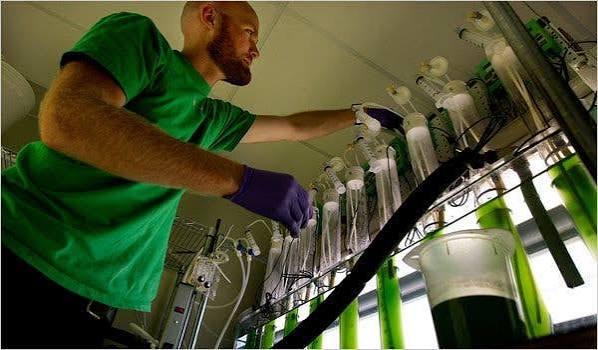
Algae are a diverse group of organisms that use sunlight or other energy sources to grow. Many types of algae use photosynthesis, a process that converts light energy, water, and carbon dioxide into organic matter.
Some algae are large and visible, such as seaweed. Others, known as microalgae, are microscopic and often grow in water.
Scientists are particularly interested in certain microalgae because some species can accumulate oils that may serve as raw materials for renewable fuels. Other species produce carbohydrates or other compounds that could be processed into useful products.
Unlike many conventional fuel crops, some algae can be cultivated without using fertile agricultural soil. Depending on the species and production method, they may also grow in brackish water, seawater, or wastewater.
These characteristics make algae an interesting candidate for biofuel production.
However, not all algae are suitable for making fuel. Oil content, growth rate, resistance to environmental changes, and ease of processing vary considerably between species.
The challenge is identifying organisms that can produce useful quantities of fuel-related material while remaining practical and environmentally responsible to cultivate.
2. Why Does the Aviation Industry Need Sustainable Fuel?
Commercial aviation depends heavily on liquid fuels because aircraft need to carry enough energy to fly long distances while keeping their overall weight manageable.
Burning conventional jet fuel releases carbon dioxide, which contributes to climate change. Aircraft also produce other emissions, including nitrogen oxides, and can influence climate through effects associated with contrails and high-altitude water vapor.
As air travel continues to support tourism, international trade, and economic activity, reducing aviation’s environmental impact has become an important research and policy goal.
Several technologies could contribute to cleaner aviation, including more efficient aircraft, improved flight operations, electric aircraft for certain short-distance applications, hydrogen-powered designs, and sustainable aviation fuels.
Sustainable aviation fuel, commonly called SAF, is particularly important because certain approved SAF types can be used in existing aircraft engines and fuel infrastructure when blended with conventional jet fuel according to applicable standards.
This means airlines may be able to reduce some emissions without replacing their entire fleets immediately.
However, SAF is not automatically carbon-neutral. Its environmental benefits depend on the raw materials, manufacturing process, energy sources, transportation, and land-use effects involved.
Algae-based fuel is one of several possible routes being studied to produce lower-emission aviation fuel.
3. How Can Algae Be Turned Into Aviation Fuel?
<AsyncImage query=”industrial algae cultivation raceway pond green microalgae biofuel production facility” aspectRatio=”16:9″ width=”100%” />
Turning algae into aviation fuel involves several stages, from cultivation to refining.
Step 1: Growing the algae
Scientists select an appropriate algal species and cultivate it in open ponds or enclosed systems called photobioreactors. Growth conditions are managed to encourage the production of useful biomass or oils.
Step 2: Supplying nutrients and carbon
The algae need suitable nutrients, water, and, for photosynthetic species, carbon dioxide. Researchers investigate ways to obtain these inputs efficiently, including the potential use of suitable wastewater or captured carbon dioxide.
Step 3: Harvesting the biomass
Once enough algae have grown, they must be separated from the surrounding water. This can involve filtration, centrifugation, flotation, or other separation techniques.
Step 4: Extracting oils or processing the biomass
Depending on the species and production method, the oils may be extracted from the algae. Other processes can convert algal biomass into intermediate products that can later be refined.
Step 5: Refining the material
The resulting oils or intermediate products must undergo chemical processing to create fuel with the properties required for aviation. Some potential pathways involve hydrotreating and other refining steps that remove unwanted compounds and produce suitable hydrocarbon molecules.
Step 6: Testing and certification
The finished fuel must meet the relevant aviation fuel specifications and undergo appropriate testing. A fuel produced from algae cannot simply be placed into a commercial aircraft without meeting applicable safety and performance requirements.
Each stage requires energy, equipment, and resources. For algae-based aviation fuel to become commercially competitive, the entire production chain must operate efficiently.
4. Algae Can Grow Quickly Under Suitable Conditions
One reason scientists are investigating algae is their potential for rapid growth.
Some microalgae can reproduce quickly when supplied with appropriate light, nutrients, temperature, and other conditions. Certain species can also accumulate substantial quantities of oils or other useful compounds.
This creates the possibility of producing significant amounts of biomass from a relatively small cultivation area.
However, growth rate alone does not determine how much usable fuel can be produced. Researchers must consider the amount of fuel obtained from each unit of biomass, the energy required for harvesting and processing, and how reliably the algae can be cultivated throughout the year.
Environmental conditions can also affect production. Temperature changes, contamination, inadequate light, and nutrient shortages may reduce yields.
In open ponds, evaporation and contamination can be difficult to control. Enclosed photobioreactors provide greater control over growing conditions but may require more expensive equipment and energy.
Consequently, the most productive system is not necessarily the most economically or environmentally sustainable one.
Scientists are working to identify species and cultivation methods that balance high productivity with manageable costs and resource requirements.
5. Algae Could Reduce Competition With Food Crops
A major concern associated with some biofuels is competition for agricultural land.
When crops such as corn or certain oilseeds are grown for fuel, they may compete with food production for land, water, fertilizer, and other resources. The extent of this problem depends on the crop, location, farming system, and how the fuel is produced.
Algae could offer an alternative because many species can grow in ponds or controlled systems that do not require conventional farmland.
Some production systems may use non-arable land, saline water, or suitable wastewater, potentially reducing competition with food crops and freshwater resources.
This could be particularly valuable in regions where fertile land is limited or where agriculture must prioritize food security.
Nevertheless, algae cultivation still occupies space and requires resources. Facilities may compete with other land uses, and wastewater may not always contain the right nutrients or be suitable for every production system.
Seawater can also introduce corrosion and equipment challenges, while saline water management and nutrient recovery require careful planning.
The key question is not whether algae can grow outside agricultural fields, but whether a complete production system can supply fuel without creating unacceptable environmental or social costs.
6. Could Algae-Based Fuel Help Reduce Aviation Emissions?
The potential climate benefit of algae-based aviation fuel depends on its entire life cycle.
When conventional jet fuel is burned, carbon that has been stored underground for millions of years is released into the atmosphere as carbon dioxide.
Photosynthetic algae can absorb carbon dioxide as they grow. If the resulting biomass is converted into fuel and later burned, much of that recently absorbed carbon may return to the atmosphere.
This creates the possibility of a shorter carbon cycle than the extraction and burning of fossil fuels.
However, absorbing carbon during growth does not automatically make the finished fuel low-carbon.
Cultivation may require electricity, fertilizer, pumping, drying, harvesting, and transportation. Refining may consume substantial amounts of heat, hydrogen, or other inputs. If these processes rely heavily on fossil energy, they can significantly reduce the climate benefits.
The source of carbon dioxide also matters. Using carbon dioxide from an industrial facility does not necessarily mean the emissions have been permanently avoided, particularly if the carbon is released again when the fuel is burned.
A credible assessment must account for emissions across the full production life cycle, including relevant changes in land use and resource consumption.
Under favorable conditions, algae-based fuels may offer climate benefits, but those benefits must be demonstrated for the specific production pathway rather than assumed.
7. Scientists Are Exploring Different Algae Cultivation Systems
Algae can be grown in several ways, and each approach has advantages and disadvantages.
Open ponds
Open ponds are relatively simple systems in which algae grow in shallow, circulated bodies of water.
They can be less expensive to build than enclosed systems, but they are exposed to weather changes, evaporation, and contamination from other organisms.
Photobioreactors
Photobioreactors are enclosed or partially enclosed systems designed to control light exposure, temperature, circulation, and other growing conditions.
They can support more controlled production, but construction, operation, cleaning, and temperature management can be costly.
Wastewater-based cultivation
Some algae can grow in suitable wastewater containing nutrients such as nitrogen and phosphorus. This may provide a useful way to recover nutrients while producing biomass.
However, wastewater composition varies, and contamination or unsuitable chemical conditions may affect growth and the quality of the resulting biomass.
Hybrid systems
Some production strategies combine different cultivation methods to balance growth, cost, and operational reliability.
Researchers may also seek to recover useful by-products, such as pigments, specialty chemicals, or residual biomass, to improve the economics of fuel production.
The best system depends on the algae species, local climate, available water, nutrient sources, and intended fuel pathway.
8. What Are the Biggest Challenges Facing Algae-Based Aviation Fuel?
Despite its promise, algae-based aviation fuel faces significant technical and economic barriers.
High production costs: Cultivation, harvesting, extraction, and refining can make algae-derived fuels more expensive than conventional jet fuel.
Harvesting difficulties: Microalgae are often tiny and dispersed in large volumes of water. Separating them efficiently can consume considerable energy and equipment.
Water and nutrient requirements: Algae need suitable nutrients, and some cultivation systems require substantial amounts of water. Recycling water and recovering nutrients can improve sustainability but may increase system complexity.
Energy-intensive processing: Removing water from wet biomass or extracting oils can require significant energy. Efficient processing methods are essential to achieving meaningful life-cycle emission reductions.
Variable yields: Algae production can be affected by weather, temperature, contamination, and changes in nutrient availability.
Scaling up production: A process that works in a laboratory may not remain equally efficient when expanded to a large industrial facility.
Competition from other fuels: Other SAF pathways, including those based on waste fats, used cooking oil, and certain agricultural or forestry residues, may be more commercially mature in particular markets.
Overcoming these barriers will require improvements in biology, engineering, energy efficiency, refining, and supply-chain management.
Commercial success will depend on whether algae-based fuel can be produced consistently at a cost and environmental impact that make it competitive with other options.
9. Could Artificial Intelligence Improve Algae Fuel Production?
Artificial intelligence could help scientists and engineers improve several parts of algae-based fuel production.
AI systems can analyze large datasets involving algae species, nutrient levels, light intensity, temperature, growth rates, and oil production. These models may help researchers identify cultivation conditions that improve productivity.
For example, an AI-assisted monitoring system could analyze sensor readings from an algae pond and recommend adjustments to circulation, nutrients, or harvesting schedules.
Machine-learning models may also help researchers identify strains with desirable characteristics, such as rapid growth or higher concentrations of useful oils. Laboratory automation could then help test promising candidates more efficiently.
AI could also support the design of refining processes, predict equipment failures, and improve energy management across a production facility.
However, AI predictions must be validated through real-world experiments. A model that performs well under laboratory conditions may not work equally well in a large outdoor pond exposed to changing weather.
AI also cannot eliminate the underlying energy and material requirements of fuel production.
Its greatest contribution may be to help researchers reduce waste, improve productivity, and identify more efficient processes, making algae-based aviation fuel more practical over time.
10. What Role Could Algae Fuel Play in the Future of Aviation?
Algae-based aviation fuel is unlikely to become a major source of jet fuel overnight. Its future will depend on scientific progress, production costs, investment, government policies, and competition from other sustainable fuel technologies.
In the near term, airlines and fuel producers are likely to rely on a range of approaches to reduce aviation emissions, including operational improvements, more efficient aircraft, and SAF produced through pathways that are already commercially available.
Algae could become more important if researchers demonstrate reliable, large-scale production with lower costs and strong environmental performance.
Certain regions may have advantages because of their climate, access to suitable water, available land, industrial infrastructure, or sources of nutrients and carbon dioxide.
However, local conditions must be evaluated carefully. A production method that works well in one region may be less effective in another.
It is also important to consider how algae fuel would fit into a broader aviation strategy. Improving fuel efficiency and reducing unnecessary fuel consumption can complement the development of lower-emission fuels.
Ultimately, the future of algae-based aviation fuel will depend not just on whether it can be produced, but on whether it can be produced sustainably, affordably, and at a scale that meaningfully contributes to aviation’s energy needs.
Final Thoughts
Algae are attracting scientific interest because they can produce oils and other compounds that may be converted into aviation fuel. Their potential to grow rapidly, use certain non-agricultural areas, and work with alternative water and nutrient sources makes them an intriguing option for reducing aviation’s dependence on petroleum.
However, the path from laboratory research to widespread commercial use remains challenging. Cultivation, harvesting, processing, energy requirements, and cost all influence whether algae-based fuel can deliver meaningful environmental benefits.
Scientists are exploring ways to improve algae strains, develop more efficient production systems, recover valuable resources, and use AI to optimize growing and processing conditions. These advances may help make the technology more practical in the future.
Algae are not a guaranteed solution to aviation’s climate challenges, and they will need to compete with other approaches that can also reduce emissions. Nevertheless, continued research could reveal useful opportunities for producing renewable aviation fuel.
The key to algae-based aviation fuel is not simply growing more algae—it is turning them into safe, affordable fuel through a production process that genuinely reduces environmental impact.