
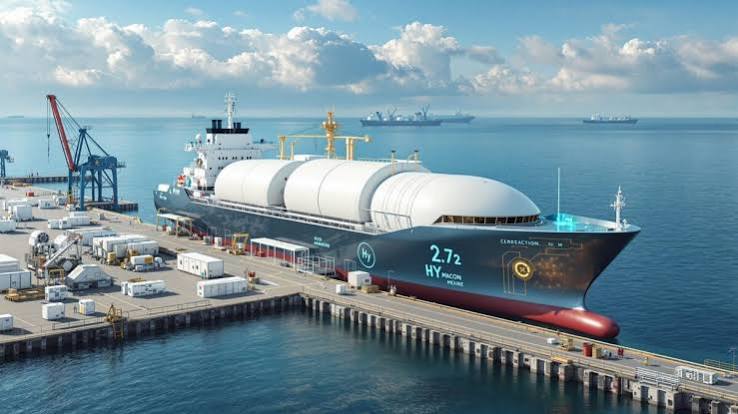
Every day, thousands of ships transport food, fuel, electronics, clothing, and raw materials across the world’s oceans. These vessels keep global trade moving, but many rely on heavy fuel oil or other fossil fuels that release greenhouse gases and air pollutants.
As countries and shipping companies search for cleaner alternatives, hydrogen is attracting attention as a potential fuel for future ships. It can be used in fuel cells to generate electricity or, with suitable engine technology, burned to produce power.
However, hydrogen-powered shipping also faces significant challenges, including fuel production, storage, cost, and the difficulty of supplying large vessels with enough energy for long journeys. Could hydrogen become a practical way to reduce emissions from global trade?
1. Why Does Shipping Need Cleaner Energy?
International shipping carries a substantial share of the goods traded around the world. Although transporting cargo by sea is often more energy-efficient per tonne of freight than transporting it by road or air, the industry still produces significant greenhouse gas emissions.
Most large commercial vessels depend on fossil fuels. Burning these fuels releases carbon dioxide, while ship engines can also produce nitrogen oxides, sulfur oxides, and particulate pollution, depending on the fuel and engine technology.
Reducing shipping emissions is challenging because vessels travel long distances, carry heavy cargo, and often operate for weeks without returning to port.
Cleaner fuels, improved ship designs, slower operating speeds, and more efficient logistics could all help reduce the industry’s environmental impact.
2. How Do Hydrogen-Powered Ships Work?
Hydrogen can power ships in several ways, depending on the vessel’s design.
One option is a hydrogen fuel cell, which combines hydrogen with oxygen to generate electricity. The electricity can power electric motors that turn the ship’s propellers.
Another option is to burn hydrogen in a specially designed internal combustion engine. This can provide mechanical power, although the system may still produce nitrogen oxides under certain operating conditions.
Fuel-cell systems produce water as their main direct reaction product and do not release carbon dioxide at the point of use. However, the overall environmental benefit depends on how the hydrogen is produced, transported, and stored.
Hydrogen-powered systems may be particularly suitable for some smaller vessels and shorter routes, where fuel requirements and refueling arrangements are easier to manage.
3. The Importance of Green Hydrogen
Not all hydrogen is produced in the same way, and its climate benefits depend heavily on the production method.
Hydrogen is commonly made from natural gas, a process that can generate substantial carbon dioxide emissions unless those emissions are effectively captured and managed.
Green hydrogen is produced by splitting water through electrolysis using renewable electricity, such as wind or solar power. When the electricity is genuinely low-carbon and production is managed efficiently, this process can offer a much cleaner fuel pathway.
However, producing green hydrogen requires significant amounts of electricity. Additional energy is needed to compress, liquefy, transport, or convert the hydrogen into a usable fuel.
For hydrogen-powered ships to deliver major climate benefits, low-emission hydrogen must be available at competitive prices and supported by suitable infrastructure.
4. Can Hydrogen Power Large Cargo Ships?
Hydrogen could help reduce emissions in shipping, but its suitability varies by vessel size and journey length.
Hydrogen contains considerable energy by weight, but it occupies a large volume compared with conventional marine fuels. Storing it often requires either high-pressure tanks or extremely low temperatures for liquid hydrogen.
These storage systems take up valuable space that could otherwise carry cargo. They also require specialized equipment and safety procedures.
For this reason, hydrogen may be more practical for ferries, port vessels, and some short-distance shipping routes than for the largest ocean-going container ships and bulk carriers.
Long-distance shipping may also use hydrogen-derived fuels, such as green ammonia or synthetic fuels. These alternatives can be easier to handle in certain applications, but their production and use introduce additional costs, energy losses, and environmental considerations.
5. The Challenges of Cost and Infrastructure
One major obstacle is the cost of producing low-emission hydrogen. Renewable electricity, electrolyzers, storage facilities, and transportation systems all require investment.
Ports would also need appropriate refueling equipment, storage facilities, trained personnel, and emergency-response procedures.
Shipping companies may hesitate to purchase expensive new vessels if suitable fuel supplies are unavailable at the ports they regularly visit. Meanwhile, fuel suppliers may be reluctant to build infrastructure until enough ships are ready to use it.
Overcoming this challenge will require coordination between shipbuilders, shipping companies, port authorities, energy producers, and governments.
Safety is equally important. Hydrogen is highly flammable and can escape through small leaks, so ships and refueling facilities require carefully engineered systems and rigorous operating standards.
6. Could Hydrogen Reduce Global Shipping Emissions?
Hydrogen could contribute to reducing shipping emissions, especially when produced using low-carbon electricity and used in applications suited to its storage and energy characteristics.
However, it is unlikely to be the only solution.
Battery-electric vessels may work well for some short routes, while wind-assisted propulsion can reduce fuel consumption on suitable ships. Other vessels may benefit from alternative fuels, improved engines, better hull designs, and more efficient shipping operations.
The best option will depend on a ship’s size, route, energy needs, available infrastructure, and the full environmental impact of its fuel.
International shipping will probably require a combination of technologies rather than one universal replacement for conventional marine fuels.
7. What Does the Future Hold?
Hydrogen technology could become more important as renewable electricity production expands and the cost of low-emission fuels changes.
Future research is likely to focus on improving fuel cells, reducing the cost of hydrogen production, developing safer storage systems, and finding efficient ways to supply ships at major ports.
Governments and international maritime organizations also influence progress through emissions targets, regulations, and incentives for cleaner vessels.
As these developments continue, hydrogen may become a valuable option for particular shipping routes and vessel types. Its wider adoption, however, will depend on whether it can compete with other low-emission technologies in cost, performance, and practical operation.
Final Thoughts
Hydrogen-powered ships offer a promising approach to reducing emissions from global trade, but their potential depends on more than the fuel itself. Clean production methods, efficient onboard systems, affordable storage, and reliable port infrastructure will all be essential.
Hydrogen may be especially useful for certain shorter routes and specialized vessels, while other low-emission fuels and technologies could prove more practical for long-distance cargo transport.
The future of cleaner shipping will likely involve several complementary solutions. If hydrogen can be produced sustainably and deployed where it makes the most sense, it could become an important part of the effort to make global trade more environmentally responsible.