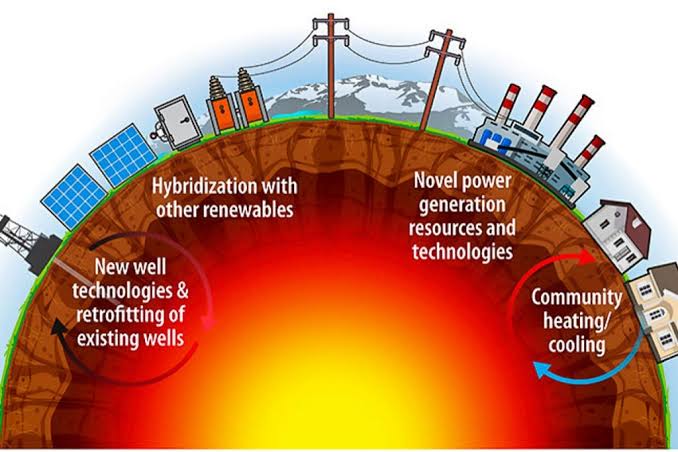
Beneath the Earth’s surface lies an enormous source of heat that could help power homes, industries, and cities for generations. Known as geothermal energy, this natural heat comes from the planet’s interior and can be used to generate electricity or provide heating.
Traditional geothermal projects often depend on locations where hot water or steam is relatively close to the surface. However, scientists and engineers are now exploring ways to access much deeper and hotter rocks, potentially making geothermal energy available in more places around the world.
As countries search for reliable, low-carbon energy sources, deep geothermal technology is attracting growing interest.
1. Where Does Earth’s Underground Heat Come From?
The Earth retains heat from its formation billions of years ago. Additional heat is produced by the natural radioactive decay of elements within the planet.
Temperatures generally increase with depth, although the rate varies depending on local geology. In some regions, hot rocks and underground fluids are relatively close to the surface, making geothermal resources easier to access.
Scientists have long used these resources to produce electricity and heat buildings. Deep geothermal exploration seeks to reach hotter underground environments that may provide more energy than conventional geothermal systems.
The challenge is finding practical ways to access this heat without making drilling and energy production prohibitively expensive.
2. Why Scientists Want to Drill Deeper
Most conventional geothermal power plants operate in locations with suitable underground heat, water, and rock formations. These conditions are not equally available everywhere.
Drilling deeper could open access to higher temperatures and potentially expand the number of places where geothermal energy can be developed.
Hotter underground resources may also provide more useful energy from a given amount of fluid, depending on the system’s design and operating conditions.
Researchers are investigating advanced drilling techniques, improved well materials, and new methods for extracting heat from deep rock formations.
If these technologies become more affordable and reliable, geothermal power could become a more widely available source of electricity.
3. How Deep Geothermal Energy Works
Deep geothermal systems typically require wells drilled into hot underground rock. Depending on the geology, engineers may circulate water through these formations to absorb heat and bring it back to the surface.
The heat can then be used directly or converted into electricity.
In conventional geothermal power plants, naturally occurring underground steam or hot water can drive turbines. Other systems use heat from underground fluids to vaporize a separate working fluid, which drives a turbine.
Enhanced geothermal systems take a different approach. They aim to create or improve pathways through hot rock so that fluid can circulate and collect heat where natural underground permeability is insufficient.
These systems could make use of hot rocks that would otherwise be difficult to exploit, although their success depends on geology, engineering, and careful management.
4. Advanced Drilling Technology Is Making Exploration Possible
One of the biggest obstacles to deep geothermal energy is drilling. As wells become deeper, high temperatures, pressure, and abrasive rock can damage equipment and slow progress.
Drilling operations can also become expensive because specialized tools and materials are needed to withstand extreme conditions.
Scientists and companies are developing improved drill bits, high-temperature electronics, advanced well materials, and techniques that can increase drilling speed.
Some researchers are also investigating unconventional methods, including technologies that use directed energy to break or weaken rock. These approaches remain at different stages of development and have not yet replaced conventional drilling across the industry.
Reducing the cost and difficulty of drilling is essential if deep geothermal energy is to become commercially competitive in more locations.
5. Could Superhot Rock Produce More Electricity?
At sufficiently high temperatures, underground water can reach conditions that may allow geothermal systems to produce substantial amounts of energy.
Scientists are investigating so-called superhot rock resources, where temperatures can exceed approximately 374°C, the critical temperature of water. At these conditions, water behaves differently from ordinary liquid water or steam.
Such resources could potentially deliver high power output from individual wells. However, operating in these environments presents serious engineering challenges.
Extreme temperatures can damage drilling equipment, corrode materials, and complicate the management of underground fluids. Researchers must also understand how rocks behave and how fluids move under these conditions.
Superhot rock geothermal energy remains an emerging area of research, rather than a widely established commercial technology.
6. Why Geothermal Energy Could Help the Clean Energy Transition
Solar and wind power are important sources of low-carbon electricity, but their output varies with weather and time of day.
Geothermal power can provide electricity continuously when a suitable resource and reliable system are available. This makes it a potential complement to renewable sources that produce energy intermittently.
Deep geothermal energy could also support industrial processes that require heat, including certain manufacturing operations and district heating networks.
Unlike fossil-fuel power plants, geothermal facilities generally produce much lower greenhouse gas emissions over their life cycle, although emissions vary by resource and technology.
Expanding geothermal energy could therefore help reduce reliance on fossil fuels while improving the diversity and reliability of electricity supplies.
7. The Risks and Challenges of Deep Geothermal Energy
Deep geothermal projects face financial, technical, and environmental obstacles.
Drilling expensive wells does not guarantee success. A site may contain less usable heat than expected, or underground rocks may not allow enough fluid to circulate efficiently.
Some enhanced geothermal projects can also trigger small earthquakes when fluids are injected underground or pressure changes affect existing faults. Careful site selection, monitoring, and management can reduce these risks.
Other concerns include water use, the handling of underground fluids, and the possibility of bringing naturally occurring minerals or gases to the surface.
Developers must assess these factors before construction and monitor conditions throughout a project’s operation.
Final Thoughts
Scientists are exploring deep geothermal energy because it offers the possibility of accessing vast underground heat resources beyond the locations traditionally used for geothermal power.
Advances in drilling, high-temperature materials, and enhanced geothermal systems could help expand access to this energy source. However, high costs, difficult underground conditions, and environmental risks remain significant challenges.
If researchers can overcome these barriers, deep geothermal energy could become a valuable part of a cleaner and more reliable energy system, supplying electricity and heat even when sunlight and wind are unavailable.